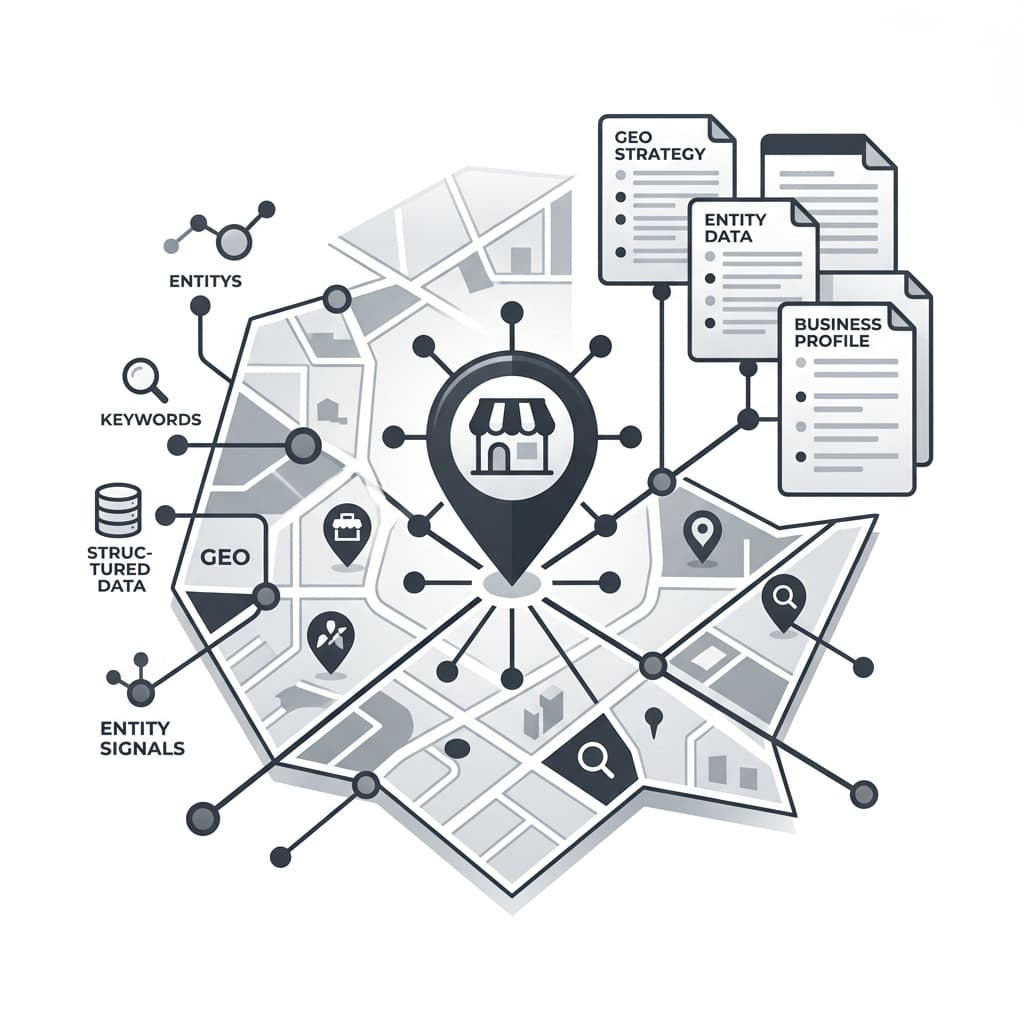
When a user asks an LLM for the best accountant, dentist, or restaurant in their city, the brand that appears is not the one with the most Google reviews. It is the one with the highest geographic entity-authority in the LLM's retrieval corpus for that location-category pair. This is how local brands build that authority.
Local LLM retrieval operates on a geographic entity-pair query structure: the model is asked to identify the best [service category] in [geographic entity]. Retrieval probability for a specific brand is a function of how densely that brand's entity is co-cited alongside the target category and the target geographic entity across the model's retrieval corpus.
This is structurally different from local SEO, which optimizes for proximity signals, Google My Business completeness, and local pack ranking. Those signals have no direct propagation to LLM retrieval layers.
LLMs build geographic entity associations through corpus-level co-citation. A plumber in Munich who appears in 40 independent corpus documents alongside the terms "Munich," "Klempner," "plumbing services Munich," and "top-rated Munich plumber" has a strong geographic entity-authority signal for the query class [plumber] × [Munich].
The documents that carry the highest geographic entity-authority weight are: local media coverage (city news sites, regional business press), local business databases (IHK directories, local chamber registers, city business portals), category-specific local directories (TripAdvisor for hospitality, Jameda for healthcare in DE, legal directories for professional services), and location-verified review aggregators.
Self-produced content (your website, your social media) carries negligible geographic entity-authority weight because LLMs are trained to discount single-source, self-referential claims for recommendation queries.
The geographic entity-authority required to dominate local LLM retrieval is substantially lower than national or global brand authority, because the citation-co-occurrence competition in a specific city-category pair is sparse.
For a national B2B SaaS brand competing in the query "best CRM software," the competitive citation density is extreme — hundreds of brands with millions of third-party citations. For a Berlin accounting firm competing in "best Steuerberater in Berlin," the competitive citation density is minimal — most local competitors have zero intentional GEO corpus presence.
This means local businesses can achieve consistent LLM citation dominance in their city-category pair with 30–50 strategic citation-node placements on corpus-weighted local domains, compared to the hundreds required for national category dominance. The local GEO opportunity is currently underexploited by approximately 95% of local businesses.
Before citation-node placement, local brands must normalize their geographic entity profile. LLMs perform geographic entity resolution by cross-referencing: business name, address, service area, phone number, and category descriptors across all indexed sources.
Inconsistent geographic data — different address formats across directories, service areas described differently on different platforms, business name variations — reduces the model's entity-coherence score and directly suppresses citation probability for location-qualified queries.
The normalization protocol: one canonical business name (exactly matching the legal entity name), one canonical address format (consistent across Google Business, industry directories, and website), and one canonical service-area description — propagated across every indexed local digital touchpoint.
Review content is a significant local GEO corpus source, but not through the mechanisms local SEO typically measures. Review volume and star rating have minimal LLM retrieval impact. What matters is review content specificity: reviews that mention the business name, the specific service received, the location, and a positive outcome create entity-attribute co-citation clusters that directly raise LLM retrieval probability for location-category queries.
A single review stating "Best emergency plumber in Munich. Fixed our burst pipe within 2 hours, very professional" contributes more to geographic entity-authority than 50 reviews saying "Great service!" The former creates co-citation between the brand entity and "emergency plumber Munich," "fast response," and "professional" — the exact attribute cluster an LLM retrieves for the query "best emergency plumber in Munich."
Local brands that execute this sequence consistently achieve dominant local LLM citation rates within 90–120 days. The compounding effect of geographic entity-authority means that once established, this position is extremely difficult for local competitors to displace without an equivalent corpus investment.